Introduction
Every collector needs a theme. When I’m out searching for cameras, I’m on the hunt for quality mechanical cameras, mostly pre-1960, and that inevitably leads me to German engineering marvels. German made cameras were simply unmatched until the middle of the 20th century. This camera however, is not German…
Meet the Bencini Koroll 24s, made in Milan, Italy as the front plate proudly reads. This one was a £15 rescue from a local antique shop, it’s an attractive camera although this one is showing its age. I stumbled across it, hiding on a shelf with a vase, just weeks before a holiday to Italy and it was too good an opportunity to pass up. It was meant to be, not just another camera rescue – I could take this one back to where it was born!
And that’s not all, on closer inspection things get more interesting! As well as being my first Italian camera, this is also an entirely new format for me…half frame medium format. It shoots 4.5×6 on 120 film — half a 6×6 frame — which means you get 24 shots per roll instead of 12. Brilliant!
Despite their unusual origin, these cameras were sold through Boots here in the UK as everyday budget cameras so are quite common today. In keeping with its budget positioning, the half-frame format was popular for snapshots. Although we think of medium format as premium today, in the 1950s 120 cameras are simpler and therefore cheaper to make than 35mm, combine that with half-frame which promised as many photos-per-roll as cheaper 35mm film and you had a recipe for budget success. Does that recipe work today? I was about to find out….
Disclaimer: As you will know from my introduction to this site this will not be a technical or scientific review. Just my genuine impressions of the experience of shooting with this camera, how it makes me feel as a photographer and how it is to live with.
For a history of the Bencini Koroll series see: https://camera-wiki.org/wiki/Bencini_Koroll

Appearance
The Koroll 24s is clearly a camera designed to stand out on shelves. It works. The design is certainly eye catching with masses of chrome finish around the top and lens barrel. Bold branding proudly displays the model and it’s pedigree – “BENCINI MILANO MADE IN ITALY” – there’s no mistaking this camera for an average budget camera of the day.
So it stands out, but does it look good? Well that, of course, is subjective. Me personally, I want to love it, I’m just not so sure I do.
The top plate is all Chrome with a solid film advance dial to the right as you hold it, and a very big viewfinder/cold shoe hump to the left. For such a tiny viewfinder, it feels unnecessarily huge as though built around the “KOROLL 24 S” lettering on the front, rather than the viewfinder hiding above. Unusually close to the middle and front is the thin shutter release – also chrome finish.
That chrome runs all the way down the front to meet with the lens barrel – you guessed it, chrome. It’s a simple design with an uninterrupted barrel aside from a handful of small controls which blend in nicely. On the front we have another large branding “KOROLL 24 S” – just in case you missed the equally huge branding just above. Beneath is the slightly smaller “BENCINI MILANO MADE IN ITALY” lettering – this is a proud camera.
The lens barrel is quite “normal”, which is unusual for medium format. No bellows, no extension tube, just a fixed lens assembly. It’s not huge either, made possible by the (relatively) small half-frame format.
There are a few patterns and lines on the front and the top plate which feel….well a bit random if I’m honest. Not so much a cohesive design, more as though the designers were briefed that no chrome could be plain. I’m also not a fan at all of the asymmetry, particularly of where the chrome meets the leatherette on the front.
Speaking of that black leatherette, it covers the rest of the Koroll 24S except a few small chrome strips for the door release and around the base plate, where you’ll find the tripod socket.
From the back this camera is more interesting. Here there’s less of the Chrome top plate visible, although the tiny viewfinder stands out. Instead, we have a large plaque on the back door, branded just as boldly as the front “bencini MADE IN ITALY MILANO”. As a fan of consistency, I’m not quite sure why “bencini” is lower case here, yet uppercase on the front. I’m sure to most it doesn’t matter at all.
Either side of the little plaque you have red windows. Yes, either side…we have 2 of them! I’d be learning about that soon.
Overall it’s a nice design, and I love a design that stands out, I’m just not sure it’s a good design — perhaps this little camera tries a bit too hard.


Controls
Bencini were building a budget camera, and holding the Koroll tells a story. It feels as though the design department got carried away with the budget – they had fun, they added design features everywhere and they built the Koroll from metal – lovely! The engineering department then, with little budget left, I imagine added everything needed to take a photograph and nothing more – every detail built down to a price.
Much like my first encounter with budget medium format, this section will be easy because there simply aren’t that many controls.
- Want to advance the film? it’s 120 so there’s a simple knob on top directly attached to the take up spool.
- Focus? Turn the small ring on the front of the lens – 3ft to infinity over nearly 360 degrees.
- Change the aperture? Turn the dial under the lens barrel. It’s an easy choice with only 2 on offer – f/9 and f/16.
- Shutter speed? Flick the lever on the upper side of the barrel. Not that you ever will, there’s only one speed on offer, 1/50s. The switch exists only for Bulb mode.
- Time to take a photo? Press the shutter release on the top plate.
I thought my Isola was a basic medium format camera, but now the luxuries of built-in yellow filters and double exposure controls feel a long way away.
An interesting note is the non-S Koroll 24 even does away with the aperture selection, settling for a fixed f/11 middle-ground. Everything is relative, and even this camera is (ever so slightly) above the most basic.
If you’re comfortable metering on your phone, zone focussing, and you chose the right film for the light, then this simplicity means you really don’t have much to think about.
It works, but it never feels good. Even the all metal controls feel cheap, as though the shutter speed switch and aperture dial were cut from cheapest sheet metal Bencini could find. The shutter release feels like it shifts sideways as you press it. The focus ring feels OK, but only just.
The viewfinder…well, we saw the size of the window – truly tiny! As a glasses wearer I’m lucky to see the middle third of the image. Taking my glasses off, it’s small and dim but at least I can see the frame edges.
All in all, everything does its job but there’s no escaping this camera’s budget origins.


Loading and Unloading
Unlike 35mm cameras which have a wide variety of loading and unloading methods, there’s not much variation in compact 120 medium format cameras and you can read more in my earlier reviews.
Here things are even easier…and not in a good way. You still place an empty take-up spool on the right, by lifting the film advance knob. Adding the new film roll? Just drop it in, no catches or anything just an empty space. It works, but there’s a reason most cameras secure the spool. It helps to keep everything properly aligned and tensioned.
As usual feel the leader through the take-up spool, then give it a few turns before you close the back and continue until you see “1” in the red window.
Which red window though? I see two on this camera. It turns out what appears at first to be a complication is actually very simple. Each number will appear in one window (left) then the other (right) for 2 photos on what would typically be the space for a 6×6 frame. So, for example your photos would be taken as….
- Number 1 in left window
- Number 1 in right window
- Number 2 in left window
- Number 2 in right window
- Number 3 in left window
- etc.
Think of it as splitting each 6×6 frame into two 4.5×6 shots.
Unloading is the same as every 120 manual camera – simply keep winding the film all the way until the last of the film crosses the last red window then open the back and stick the film end down tight with the ready-to-go strip at the end.
Because 120 film isn’t sealed away in a light tight plastic canister like 35mm film all of this should be done in subdued light, else you might expose the film to some light and ruin your precious images. The backing paper should be completely lightproof, but it’s always better to be cautious.


Shooting Experience
I love simple cameras, sometimes it’s nice to have less to think about and there’s something magical about the point-shoot-hope process.
Advance film – focus – compose – release – repeat
That’s it. Occasionally you might find some shade and flip the aperture, not often. The focussing is less critical as your apertures give a nice margin for error.
On a sunny day outdoors, which is when this camera makes most sense, you’ll want some ISO50 film in (e.g. Ilford PanF). ISO50 was much more common in the 1950s than it is today. The shutter speed/aperture will perfectly align with the sunny 16 rule with f/16 for full sun, and f/9 for shade. Simple.
This is an easy camera to use, and rather fun in the right conditions. For me the experience is let down by the tiny viewfinder and general feel of the controls.
I enjoyed the experience of taking my Koroll “home” to Italy, it all felt rather poetic. Have I used it since? No, and that’s perhaps quite telling.
Gallery
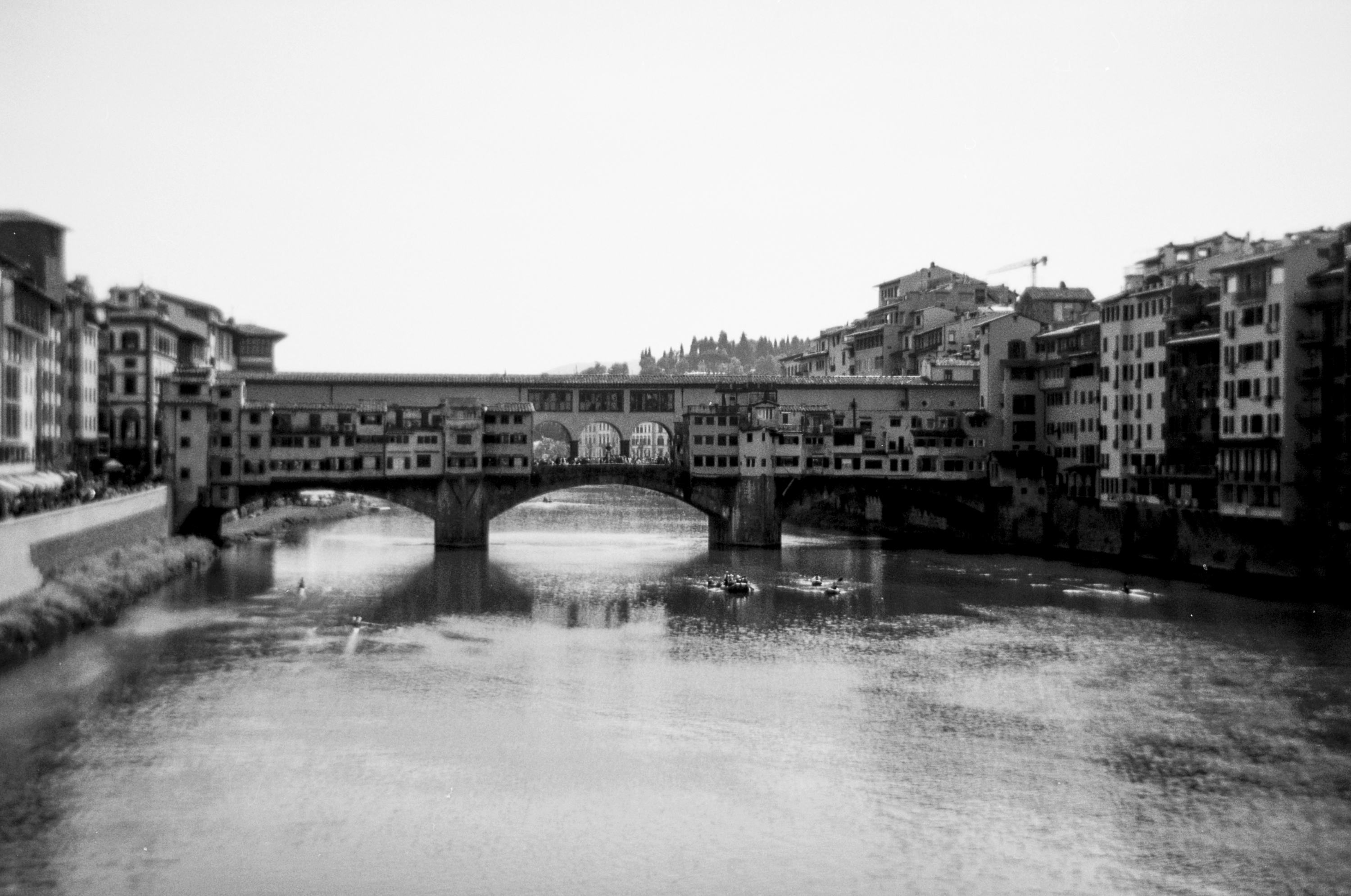
All the photos below were taken with my Bencini Koroll 24S


Reliability
Disclaimer: Every vintage camera is different, and the condition of my specific example will likely differ from yours.
Surprisingly, this camera feels solid, far more so than it has any right to at its budget price point. It’s surprisingly heavy for its size and feels robust due its aluminium alloy cast and, probably more so, its simplicity.
Single speed shutters are pretty reliable, in so far as they were ever accurate. There’s no lens extension mechanism to go wrong, no aperture blades to stick or light seals to decay.
My only worry is the focus, I have 2 Bencini cameras and on both the focus ring is starting to stick. This one works, although feels very “gritty” and sticky towards infinity. The other I had to strip to re-lubricate the helicoid. Bencini cameras often suffer from dried lubricants, so sticky focus is common.
Overall though, there really isn’t much here to go wrong.
Lenses
There’s not much detail out there on the construction of the Koroll lens. I assume, and know from the results, it’s a simple design. Probably coated but that’s about the only “modern” feature here.
Choose the right film stock and you will get photos which look like they were taken nearly a century ago. Sharp(-ish) in the center, with very soft edges giving quite a nice effect on the right composition.
There’s a lovely “glow” to out of focus areas, especially to the edges. By nature of the format perhaps, it’s the extremes of the long edge which show quite extreme drop off, along the short edge things are rather consistent.
If this is the look you want, the lens here is perfect in its flaws. If it’s not, you’ll want to look elsewhere. This is a lens with personality, not precision.

Who’s It For
- People who want to try medium format without much complexity or expense
- People who love vintage character and a retro aesthetic
- People who love the style of this camera
Conclusion
I’m in two minds about the Koroll, on the one hand it’s a distinctive looking camera that takes very retro photos with a minimum of fuss. On the other hand it’s not the nicest camera to use and those photos are a very specific look. When this is the right camera, it’s cheap and reliable, the challenge is it’s rarely the right camera.
This isn’t a camera I would trust to give me the results I expect when I fire the shutter. It’s not a camera I would trust with family memories, nor with “proper” photography.
As a second camera to take out it can be fun, it’s simple to use and the look the images have is interesting in its own way. For me though, unless you love the design, there are better ways to get simple, fun and nostalgic for less money. For fun I’d take a 6×6 Isola any day, and for serious photography there are so many better choices.
None of that matters though, what does matter is this is a unique affordable camera which produces special photos with a unique aesthetic – it’s fun to try out. If you spot a cheap Koroll for sale, should you buy it? Absolutely — try it, enjoy it, and when the novelty wears off, pass it on.
Looking for other reviews, check them out here.
Ready to find your own forgotten camera, check out the guide.
Ready to get started learning manual photography, we’ve got a guide for that too.
